
 Blockchain
 Crypto Mining
 Cryptocurrency
 DAO
 DeFi
 Decentralized Exchanges
 Financial Services
 Fintech
 SPACs
 Web3
 AI
 App Developers
 Cloud Computing
 Education Technology
 Esports
 Influencers
 IoT
 MSPs
 Media & Advertising
 Podcasters
 Robotics
 SaaS
 Social Media
 Startups
 Technology
 TikTok Creators
 Virtual Reality
 YouTubers
 Biotech
 Cleantech
 Clinical Trials
 Dietary Supplement & Nutraceutical
 FamTech & BabyTech
 HealthTech
 Life Science Risk Management
 Pharmaceutical
 Advertising Agencies
 Amazon Seller
 Direct-to-Consumer Brands
 Ecommerce
 Financial Services
 PR Agencies
 Professional Services
 Publishers
 Shopify Stores
 innovation@baldwin.com
 New York, NY
 646.854.1058



Jonathan Selby
General Manager; Technology Practice Lead
Key Takeaways
General Manager; Technology Practice Lead
Since the rise of AI in 2022, the legal risk mitigation landscape, once underpinned by a “wait-and-see” attitude, has shifted its approach to “Absolute AI Insurance exclusion.”
Companies deploying AI are doing so with greater focus and precision as their understanding of AI’s capabilities grows. At the same time, as the initial AI hype dies down, the insurance market has come to demand greater accountability. The result? Carriers are completely stripping AI coverage from standard, off-the-shelf policies.
Fortunately, this demand for specificity is an advantage for startups looking to tailor their policies. If companies and brokers don’t negotiate specific carve-backs, the company ends up carrying massive uninsured liabilities. This could eventually halt investment opportunities and block growth. Let’s explore some of the gaps in off-the-shelf coverage, why this insurance coverage matters, and actionable steps startup leaders can take to ensure adequate protection in the age of AI.
The 5 Major Coverage Gaps In Your Policy
Identifying AI-shaped holes in an insurance policy isn’t as simple as scouring for the phrase “AI exclusion.” But reviewing how a policy is structured and whether certain exclusions are present can reveal whether a company deploying AI has adequate coverage.
Whether a founder is reviewing an existing policy or looking to acquire a new one, here are some AI insurance exclusions to look out for.
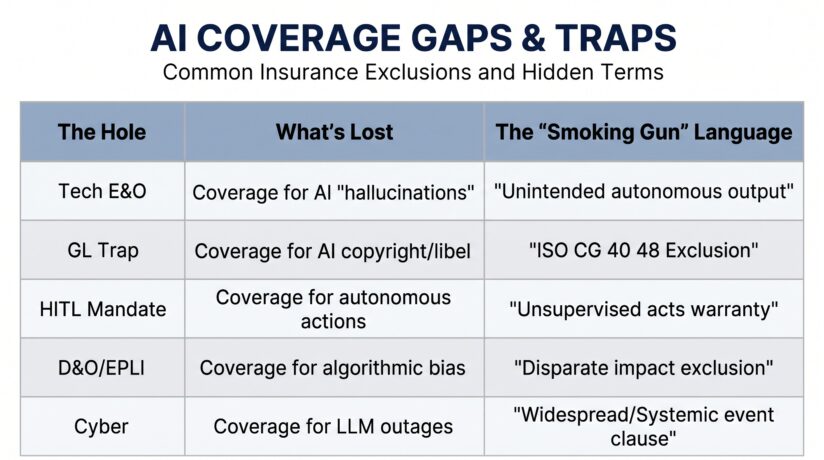
1. The Tech E&O Gap: The “Algorithmic Output” Crisis
Business leaders might think their Errors & Omissions (E&O) policy is enough to cover a professional mistake. This is true, with a caveat—traditional policies only cover human mistakes, not those made by machines.
For instance, if an AI model gives shaky financial advice that results in a financial loss, or a medical AI misinterprets a scan, carriers wouldn’t view this as a professional service error but an excluded unintended consequence of an autonomous system. Thus, E&O wouldn’t be triggered in these cases.
Many policies now include a “computer violation” or “data processing” exclusion that specifically targets damage caused by automated code execution without human intervention. The fix? A tech E&O that endorses “vicarious liability for AI.” Otherwise, startups are self-insuring their core product.
2. The General Liability Trap: ISO CG 40 48
Commercial general liability (GL) as we know it usually covers personal and advertising injury, such as libel, slander, and copyright infringement. However, a recent ISO CG 40 48 endorsement effectively prevents anything made with generative AI from being covered under GL.
So, if a marketing team uses Midjourney or ChatGPT to create a campaign that culminates in an intellectual property infringement, copyright infringement, or digital defamation legal battle, a standard GL policy won’t be triggered. Instead, the company is faced with 100% of the cost. Most companies can’t afford the financial loss tied to such litigation risks.
An ISO CG 40 48 endorsement is a total exclusion of the usual GL insurance coverage B (which doesn’t involve bodily injury or property damage) when generative AI is concerned. It treats any AI-generated content as a high-risk pollutant that can’t be protected under personal and advertising injury.
3. The “Human-in-the-Loop” Mandate for Product Liability
If AI acts, decides, or communicates without a human checking the box first, any claim arising from these interactions is excluded from coverage under the unsupervised autonomous act exclusion.
This is where enforcing HITL goes beyond an operational best practice and turns into a warranty requirement in the insurance contract. If companies tell underwriters that they have HITL in place, but a claim proves them otherwise, the insurer can deny the claim based on misrepresentation of risk.
Essentially, insurers are only willing to insure humans and their decisions—not an autonomous AI algorithm.
4. D&O/EPLI Exposure: The “Disparate Impact” Exclusion
The lines of intent blur even more when AI enters the picture. Directors & officers (D&O) and employment practices liability (EPLI) won’t rescue a company from costs associated with algorithmic bias—for example, an AI hiring tool filtering out a protected class from an applicant pool.
Even if leadership didn’t intend to discriminate against an employee or client, they’re still faced with a potential liability for disparate impact. As a result, many carriers are adding absolute AI exclusions to D&O and professional liability policies to avoid class-action suits stemming from black box decision-making.
For instance, if a board approves an AI tool without due diligence on its bias protocols, a carrier could argue that the board acted with reckless disregard. This would trigger an insurance coverage denial on the basis of conduct exclusions.
5. The Cyber “Widespread Event” Clause
As more companies hire popular AI services to support operations, cyber liability policies have adapted to the new risk landscape. Suppose OpenAI or Amazon Web Services (AWS) goes down or suffers a data breach and takes thousands of startups with it; carriers can’t afford to shoulder all the claims at once.
This is a systemic risk hole. A cyber insurance policy might cover a hack on a company’s server, but it likely excludes widespread events or contingent business interruption caused by a major LLM provider outage.
Today, the insurance industry is moving toward “sub-limits” or “total exclusions” for infrastructure failure. If a startup’s entire value proposition relies on a single API, such as GPT-4, then they’re one major outage away from an unrecoverable and likely uninsured business interruption.
Why “Standard” Isn’t Enough Anymore with AI Insurance Exclusions
So what’s the key takeaway? Ultimately, a “standard” policy might not suit the needs of high-risk industries deploying artificial intelligence. We’ll break down why in the section below.
Generalist Insurance Brokers and AI-Allergic Insurance Coverage
A few years ago, a generalist broker could confidently opt for a standard tech E&O policy to offer comprehensive coverage for most startups. Today, these off-the-shelf products include absolute AI insurance exclusions by default. This leaves major gaps for companies deploying AI.
It can be helpful to think of a generalist broker as a general practitioner performing heart surgery. Founders might see the word “technology” on the policy and believe a startup is automatically covered. But this ignores the silent AI-specific exclusions buried in the endorsements. The insurance industry is terrified of systemic AI risk—if one AI model fails, it fails for everyone. To protect their balance sheet, their standard stance has become AI-allergic, excluding everything AI-related by default. This is why it’s never been more important to connect with specialized brokers.
In 2026, specialized coverage isn’t a luxury. It’s a survival requirement for companies adopting AI tech. Determining which broker is best for a startup comes down to the small details and their industry range.
The “Carve-Back” Solution: Building vs. Buying
Business leaders should view insurance as a custom legal fortress, not a one-and-done policy purchase. This is where carve-backs make all the difference.
Carve-backs are exceptions inside an exclusion. If a policy says “We don’t cover AI,” a carve-back says “Except for the specific AI-driven diagnostic tool described in your application.” This is the level of tailoring founders must look for. If you don’t see carve-back language included, you can safely assume AI coverage is completely excluded.
So, how should startups negotiate their policy terms? This is a technical audit divided into three parts:
- Step 1: A broker identifies an absolute AI exclusion.
- Step 2: The startup provides HITL documentation and bias testing results.
- Step 3: The underwriter agrees to include a carve-back for that specific, vetted AI use case.
This process is comparable to disclosing a pre-existing condition to a health insurance company. The patient must prove their condition is managed and monitored before the carrier will agree to insure it. For that patient, the carve-back is where the real protection lies, not the base insurance. This is exactly the same as an AI exception included as an endorsement.
Actionable Steps for Founders in the Generative AI Era
At this point, founders might be wondering which of these AI exclusions are incorporated into their policy. If so, here’s what they can do to examine and improve their startup’s coverage.
Audit the Endorsements
Look for the fine print in your policy. Most founders stop at the Declarations Page, which is just a summary. Instead, review the Endorsements section located in the extra pages at the end of a policy.
Look for deal-breaker phrases like “absolute AI exclusion,” “ISO CG 40 48,” “Non-human author,” and “Automated Decisioning System.” If they’re there, your AI-generated marketing, customer support bots, and automated code are likely uninsured.
Document Your HITL
Today’s underwriters are risk-averse by default, especially when it comes to AI-related risks. Securing AIc coverage means proving a human is still driving the bus, so to speak. This is why a HITL workflow has become a startup’s most valuable insurance asset. It’s the difference between a $50,000 premium with coverage and a $5,000 premium that pays nothing out.
Founders are wise to create a HITL dossier that answers the following questions:
- Is there a system in place to take the AI offline if it goes rogue?
- Who is responsible for reviewing AI-generated output before it reaches a customer? Is it an AI developer, or someone else?
- How do you retrain models when they produce hallucinations?
Adopting a “No-Secrets” Policy to Avoid AI Failures
In the early days of AI, companies could get away with not disclosing their AI vendor integrations or use of standalone AI products. At this point, AI was an emerging risk, tech companies were trialing it, and litigation and the insurance industry had not yet caught up with innovation. The 2026 landscape is different. Now, silence is considered a material misrepresentation.
If founders claim they’re a SaaS platform but are actually an AI-Agent-as-a-Service provider, a carrier will use that discrepancy to deny insurance claims very quickly.
As such, it’s best to be radically transparent during the insurance application process. This means disclosing everything, including whether a company is deploying AI, which tools, and how they operate within the business. If a claim arises from a third-party LLM outage and founders never disclosed their critical dependency on it, the carrier can argue they never underwrote this specific systemic AI risk.
Since 2022, tech innovations have occurred at significant speed. In 2026, insurance exclusions moved even faster. A business leader who understands her exclusions before it’s time for a deposition is in a much better position than one who doesn’t. Specialized brokers and tailored policies shield companies from AI-related risk and keep startups properly protected as they navigate a sea of AI exclusions.
Insurance Rebuilt, End-to-End