Blockchain
 Crypto Mining
 Cryptocurrency
 DAO
DAO
 DeFi
DeFi
 Decentralized Exchanges
 Financial Services
 Fintech
 SPACs
SPACs
 Web3
Web3
 AI
AI
 App Developers
 Cloud Computing
 Education Technology
 Esports
 Influencers
 IoT
IoT
 MSPs
MSPs
 Media & Advertising
 Podcasters
 Robotics
 SaaS
SaaS
 Social Media
 Startups
 Technology
 TikTok Creators
 Virtual Reality
 YouTubers
 Biotech
 Cleantech
 Clinical Trials
 Dietary Supplement & Nutraceutical
 FamTech & BabyTech
 HealthTech
 Life Science Risk Management
 Pharmaceutical
 Advertising Agencies
 Amazon Seller
 Direct-to-Consumer Brands
 Ecommerce
 Financial Services
 PR Agencies
 Professional Services
 Publishers
 Shopify Stores
 info@foundershield.com
  28 Liberty Street, New York, NY 10005
  646.854.1058



Kyle Jeziorski
Senior Director, New Business & Placement
Key Takeaways
Senior Director, New Business & Placement
There’s rarely a moment more important in a founder’s life than the day they finally close an M&A deal. Their efforts from a small VC-backed project to many years of stretching runways have finally paid off, becoming part of a larger enterprise that had a primal need for what they offer.
The champagne flows, every executive makes a toast to their achievements, and there’s no cause for concern since the founder purchased a six-year Directors and Officers (D&O) Tail policy, or run-off coverage, that will help them sleep well at night now that they have a few million in fresh coverage for the next six years. Or so they think.
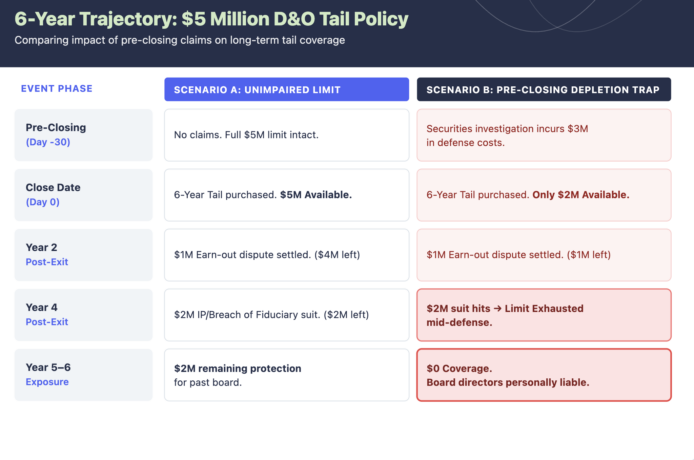
This is a massive misconception that still catches startup leaders by surprise. The truth is that Tail policies typically do not refresh or reinstate limits. A pre-closing claim or investigation can deplete the limit before the tail period even begins, leaving directors exposed many years later. Such a policy is only as strong as its underlying policy limit. For true post-exit protection, founders must understand shared limits and depletion mechanics, or make costly mistakes. Let’s dive in.
Policy Mechanics 101: How Tail Limits Actually Work
Tail policies, as an endorsement to an already existing policy, might be prone to many misconceptions. Plainly, this type of coverage is referred to as an extended reporting period (ERP), which continues to cover claims after a policy’s expiration. However, it does not issue a brand-new policy year the moment it gets purchased and does not add a higher coverage ceiling—if the D&O limit is $5 million, the Tail is included in this amount, which remains throughout, and doesn’t add another $5 million when founders secure it.
To be more specific, this single aggregate limit of liability will apply across the entire six-year run-off period combined, and should be able to withstand this period. Otherwise, companies run the risk of paying out-of-pocket once claims overrun the set limit during the following six years.
The Trap of Pre-Closing Depletion
To better explain Tail policies, let’s set the scene: Suppose a claim hits 30 days prior to an M&A deal closing. Legal defense costs and settlements draw down $3 million of a $5 million policy limit. As a result, the company enters the six-year Tail with only $2 million in remaining coverage, which must now stretch over 72 months to protect all past directors and officers.
What happens when defense costs eat the entirety of the limit before the six years are up? This is when defense obligations would cease, and directors are forced to bear the post-exit litigation costs, such as shareholder suits, earn-out disputes, and tax or regulatory inquiries.
Negotiation & Advisory Strategies: How to Protect the Limit
As a Tail extends the coverage period, but not the coverage limit, it’s key for founders to know how to use and protect it wisely. The mission might be to shield directors and officers from the trials and tribulations of legal claims after an M&A or even an assignment for the benefit of creditors (ABC). Although two very different processes, the goal remains the same: to stretch a Tail limit to last the entirety of its coverage period. Here are some ways to do it.
Reinstate Limits or Unimpaired Limit Endorsements
There’s nothing like striking a negotiation with insurers before signing papers and setting everything in stone. After all, good insurance is meant to wrap around a company’s unique shape, not offer a cookie-cutter solution that forces founders to cut corners and stay partially unprotected.
As such, Tail policies can also be molded to a company’s specific needs with certain endorsements, including its limits. Startup teams must negotiate with underwriters before signing their exit agreement to ensure the Tail starts with a fresh, un-depleted limit on the transaction date, regardless of pre-closing claims. This lends much-needed peace of mind for founders who might’ve run into claims prior to closing an exit deal that uses part of their limit.
Add a Dedicated Side A Protection as the Ultimate Safety Net
Side A coverage is a must-have, whether a startup is still riding the fundraising wave or eyeing an exit deal. That’s because, when D&O insurance can’t cover a director’s or officer’s legal fees due to legal or financial conflicts, Side A kicks in to protect their personal assets. In short, it helps avoid potentially catastrophic losses for executives’ personal patrimony.
But this might not be enough to protect the Tail limit. A Difference-in-Conditions (DIC) might do the trick as an addition to Side A coverage. DIC is an excess layer that comes to the rescue when indemnification is simply not possible for whatever reason, building a comprehensive insurance tower that adds extra limits to the already existing D&O Side A policy.
Timing the Tail Purchase Right
Term sheets are the ultimate statement of what an M&A deal will entail, sealing the fates of the buyer and the seller. The right due diligence before signing will be paramount to how advantageous the deal is for both parties, including the specification of insurance duties for each one.
If a startup is seeking the purchaser to cover limit reinstatement costs, or the other way around, this must be explicitly mentioned in the merger agreement or term sheet alongside the necessary Tail structure. Settling this in writing will avoid last-minute friction before or after signing the exit deal.
Standalone Tail Policies vs. Buyer’s Policy Continuity
Playing the cards right also means knowing when to rely on the buyer’s existing coverage moving forward or purchasing an independent run-off policy that will see the startup through during and after an M&A deal.
Is the buyer’s corporate coverage comprehensive enough to cover the potential exposure of inherited risk? Can founders negotiate a good enough run-off policy that will bring extra protection without risking directors’ and officers’ pockets?
The D&O Insurance Tail Rule of Thumb
Ultimately, it’s key for founders to know what they’re getting into when purchasing a six-year D&O Tail. Terms not clear? Ask your broker as many questions as you can.
As an overview, it’s crucial to understand that a Tail adds a duration of six years (typically) to cover executives for past wrongdoings after the company’s D&O policy expires following an M&A deal, or similar exits. It doesn’t mean that its limit will be refreshed for the next six years. For that to be a reality, founders must audit their current D&O limit well before M&A negotiations peak to secure advantageous insurance coverage that won’t leave them and their personal assets stranded when the company merges or ends.
Tail coverage shouldn’t be an afterthought in deal prep. At Founder Shield, we audit policy structures early so your board is fully protected long after the deal closes.
Planning an exit or negotiating a tail policy? Contact our Risk Advisory team to review your D&O policy mechanics today.
Insurance Rebuilt, End-to-End