

 Blockchain
 Crypto Mining
 Cryptocurrency
 DAO
DAO
 DeFi
DeFi
 Decentralized Exchanges
 Financial Services
 Fintech
 SPACs
SPACs
 Web3
Web3
 AI
AI
 App Developers
 Cloud Computing
 Education Technology
 Esports
 Influencers
 IoT
IoT
 MSPs
MSPs
 Media & Advertising
 Podcasters
 Robotics
 SaaS
SaaS
 Social Media
 Startups
 Technology
 TikTok Creators
 Virtual Reality
 YouTubers
 Biotech
 Cleantech
 Clinical Trials
 Dietary Supplement & Nutraceutical
 FamTech & BabyTech
 HealthTech
 Life Science Risk Management
 Pharmaceutical
 Advertising Agencies
 Amazon Seller
 Direct-to-Consumer Brands
 Ecommerce
 Financial Services
 PR Agencies
 Professional Services
 Publishers
 Shopify Stores
 innovation@baldwin.com
  New York, NY
  646.854.1058



Key Takeaways
Excess Insurance: The Follow-Form Layer
The word “excess” is often used to mean having too much of something; a little extra. In the insurance context, this would also be right. Excess insurance is a straightforward, vertical extension of an existing primary policy, such as general liability (GL).
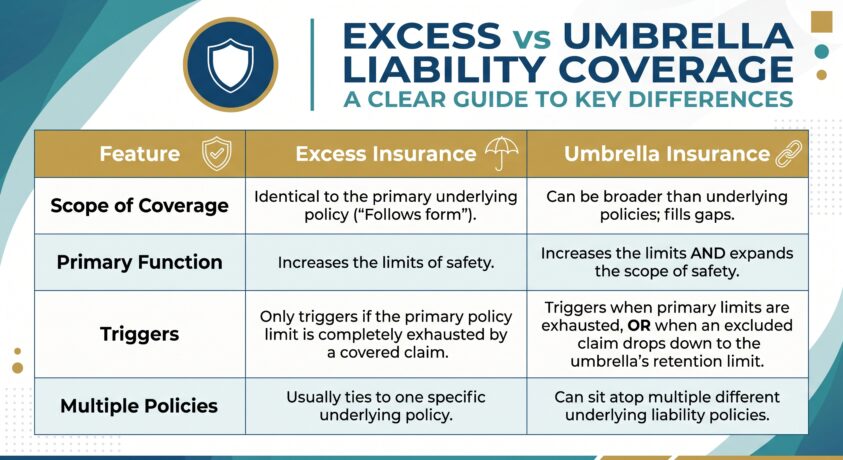
The way it works is by adopting the exact same terms, conditions, and exclusions as the underlying policy. Basically, if the primary policy doesn’t cover a claim, the excess policy won’t either.
Think of it like this: It’s like building your fence and eventually realizing it works, but it could do with a bit more height. So, the solution is buying a taller fence of the exact same material. That’s the excess. It provides you with more of the same, with nothing new added into the taller portion purchased.
Umbrella Insurance: The Broadener
Now, umbrella insurance is a broader policy that sits over multiple primary policies, such as GL, Auto Liability, Employment Practice Liability (EPL), etc. This “sitting over” is what might make things muddy, leading people to believe excess and umbrella coverages are the same thing. However, an umbrella policy offers extra protection in another way.
Our Placement Executive, Mike Lappat, puts it plainly: “An umbrella policy doesn’t just add another layer of the exact same coverage—it can actually introduce entirely new coverages for exposures that the primary policy might exclude entirely.”
Mike also explains that the magic of an umbrella policy is that it can “drop down” to cover gaps or exclusions in primary policies, and this is where it highly differs from excess coverage. In turn, it adds new types of coverage.
For instance, suppose you’ve already bought your fence and you feel quite protected. Adding an umbrella policy is literally like putting a massive umbrella over your property. It will catch what the fence misses by adding extra protection between the gaps the underlying policy and the excess coverage miss.
Head-to-Head Comparison
To compare both, founders should perceive excess insurance as a copycat, and the umbrella insurance as a safety net with a wider weave. Let’s illustrate it more clearly with this table:
How to Choose: Scenarios
Knowing what both terms mean is only half of the story for founders. Knowing how to choose completes the puzzle, allowing for the right decisions to be made when you need them.
Scenario A: When Excess Insurance Is the Right Move
Excess insurance is ideal when primary coverage is structurally perfect for a company’s needs, but the dollar amount of protection is simply too low to satisfy a contract, a landlord, or overall risk tolerance. It follows form, meaning it acts as a carbon copy of an underlying policy.
This hardware manufacturer scenario can help illustrate this. Suppose a commercial plastics company manufactures heavy-duty brackets sold to thousands of HVAC installation companies in the country. They operate with an excellent products liability policy that protects them with a $2 million limit. Suddenly, a specific batch of brackets suffers a chemical mixing defect, causing them to crack under stress. Over the next six months, hundreds of commercial AC units collapse nationwide, causing massive property damage to the buildings where they were installed.
The aggregate wave of property damage lawsuits hits $5 million. How will the company fare?
In this case, if the manufacturer already has a $5 million excess Products Liability policy, they’re set. The excess doesn’t add any new wording or broader protections. It simply does its job of extending the company’s financial runway from $2 million to $7 million so the manufacturer doesn’t have to pay the $3 million shortfall out of pocket.
The same goes for an IT consulting firm that secures a contract with a Fortune 500 client. The client’s legal team will require the firm to carry $10 million in GL coverage, when they only have $2 million at its disposal. Instead of rewriting their entire insurance plan, the firm can simply buy an $8 million excess GL policy to satisfy the contract quickly and more affordably.
Ultimately, excess coverage is a siloed solution. For example, an excess auto policy will not help if a slip-and-fall claim exhausts the GL policy since that’s not the policy the excess was applied to.
Scenario B: When Umbrella Insurance is the Right Move
We recommend umbrella insurance when companies have multiple moving parts, diverse liability exposures, or known gray areas where their primary policies end but their risk continues.
Let’s study the scenario of a global operations company. This US-based manufacturing business is expanding and beginning to hire remote sales representatives in Europe. Their primary US GL policy explicitly excludes lawsuits filed in foreign courts, so they’re in a pickle if any claims in Europe ever arise.
To fix this, the company secures a commercial umbrella policy that includes worldwide coverage—when a lawsuit hits, the primary US policy won’t cover it, but the umbrella will drop down to save the day as the primary defender (minus a self-insured retention fee). This way, the company’s insurance introduces a brand new geographic coverage that didn’t exist before.
Another good example is the multi-layered disaster scenario that hits a hospitality group. This business owns a boutique hotel with a restaurant, a valet service, and an employee pool. A catastrophic fire results in liquor liability lawsuits, auto damage from the valet, and employee injury claims all at once.
The hospitality conglomerate solves this by acquiring a single umbrella policy that sits atop its GL, commercial auto, and EPLI policies simultaneously. It can absorb shocks coming from any or all of these angles, preventing a multi-front claim from bankrupting the business.
Quick Decision Matrix for Buyers
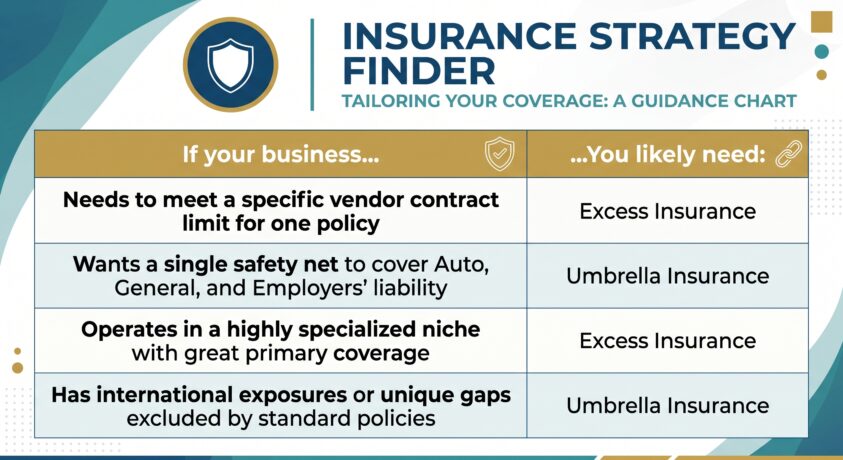
If founders are still unsure about what they need, let’s look at this decision matrix for buyers:
Time for a Risk Assessment
Many of the companies in our scenarios didn’t have what they needed to cover the claims and requirements they faced. In real life, this could’ve cost them deals and many out-of-pocket headaches that are usually difficult to bounce back from. If your business is facing new opportunities and exploring new markets, don’t let this be you—filing an insurance claim is the worst time to find out where your coverage ends.
Founders must ask themselves, “Is my extra layer of protection a restrictive excess policy or a flexible umbrella?” Stacking policies without looking at the underlying language is one of the biggest risks a growing business can take. If you’re still wondering, then it’s time to take a risk assessment so a team of experts can audit your current portfolio and ensure you have the right safety net in place.