

 Blockchain
 Crypto Mining
 Cryptocurrency
 DAO
DAO
 DeFi
DeFi
 Decentralized Exchanges
 Financial Services
 Fintech
 SPACs
SPACs
 Web3
Web3
 AI
AI
 App Developers
 Cloud Computing
 Education Technology
 Esports
 Influencers
 IoT
IoT
 MSPs
MSPs
 Media & Advertising
 Podcasters
 Robotics
 SaaS
SaaS
 Social Media
 Startups
 Technology
 TikTok Creators
 Virtual Reality
 YouTubers
 Biotech
 Cleantech
 Clinical Trials
 Dietary Supplement & Nutraceutical
 FamTech & BabyTech
 HealthTech
 Life Science Risk Management
 Pharmaceutical
 Advertising Agencies
 Amazon Seller
 Direct-to-Consumer Brands
 Ecommerce
 Financial Services
 PR Agencies
 Professional Services
 Publishers
 Shopify Stores
 innovation@baldwin.com
  New York, NY
  646.854.1058



Kyle Jeziorski
Senior Director, New Business & Placement
- Mapping Your SpaceTech Risks: The Valley of Death
- The Underwriter’s Scorecard for Space Insurance
- Product Roadmap: Pre-Launch, Launch, and In-Orbit Risk Management
- Beyond the Hardware: The Investor-Ready Approach
- Real-World Case Studies
- The 2026 Regulatory Landscape
- Turning Risk into a Competitive Edge
Key Takeaways
Senior Director, New Business & Placement
From frequent SpaceX test flights to the recent Artemis II mission, where four astronauts traveled around the moon, the private and public SpaceTech sectors are thriving. On the private side, spirits are up, and the space industry has been receiving significant investment backing: the sector has created 17 unicorns, with around a thousand companies collectively raising $74.6 billion in VC and private equity. About half of these projects have reached the Series A+ status, signaling a small yet maturing sector that’s poised to continue growing.
As an industry filled with hopes of launching through hardware-intensive high tech, insurance is no longer a back-office line item, but rather a C-suite strategic asset. Today, it has become essential to secure a launch contract, demonstrating to Series A and B investors that the company has moved beyond sketches and prototypes and into tangible, achievable results. Let’s browse the most prominent SpaceTech risks and the necessary steps deep-space underwriting experts are taking to protect founders and their startups.
Mapping Your SpaceTech Risks: The Valley of Death
SpaceTech defines the industry powering space exploration—the physical tools, software, and other technological breakthroughs needed to see the stars from up close and our planet from above. This isn’t, evidently, without facing unique risks, whether it’s about launching satellites for GPS services or the more controversial space tourism.
The Core of the Valley of Death
After setting foot on the moon, Neil Armstrong famously said, “That’s one small step for man, one giant leap for mankind.” That’s what the Valley of Death can signify for a SpaceTech company. While avoiding sounding too dramatic, this is the operational gear-shift from R&D to launching into orbit, where plans leave pen, paper, and protected lab environments and move into live use.
This shift is where many startups fail to adjust their coverage, doing it way after it’s needed. This means they begin operations with R&D-grade protection that doesn’t suit their new live-grade exposures.
IP & Cyber Insurance: The Invisible Asset Risk
The hard-earned operational phase of a company is the fruit of years of labor crafting vital Intellectual Property (IP) data. In SpaceTech, companies are surely valued for the hardware they build, but also for the code that runs it and the data it beams down. It’s also their biggest attack surface.
Some of the most prominent space industry risks include command-and-control (C2) hijacking on the cybersecurity side and patent trolling in the new space race, which involves all aspects of IP.
In the early stages, elements like IP are the most powerful assets a SpaceTech company has—if a data breach ever takes place, and a competitor runs with a proprietary propulsion design they took from the startup, the company’s valuation evaporates. Ultimately, protecting IP is a fiduciary responsibility to the board.
The Kinetic Risk: Bodily Injury & Property Damage Insurance Policies
Everything becomes too real and tangible once startups shift to testing and commercializing their product. This is where they could meet the “hard reality” of the industry. As hardware startups in this sector will mostly build tools for other companies, third-party liability (TPL) is inevitable.
Once ready to launch, TPL becomes the essential protection against mission-ending litigation, which protects from damage to people and property. If a launch vehicle fails and debris hits a populated area of a high-value ground station, the liability could exceed the company’s entire net worth and nuke its prospects.
Contractual & Regulatory Exposure
Although we’re past the space race era, companies across the globe are trying their hardest to see who will reach the next milestone outside the exosphere. This global eagerness resulted in international standards that apply to any company, whether it’s a US startup operating exclusively on American soil.
This is the licensing-to-insurance pathway. For instance, companies can’t get a Federal Aviation Administration (FAA) launch license without showing proof of insurance that meets international treaty standards. If they take the risk, a regulatory fine or a contract breach penalty due to licensing delays can be just as fatal as an explosion on launch day.
The Underwriter’s Scorecard for Space Insurance
Deep-space underwriting experts already know exactly what they’re looking for when it comes to insurability. To protect their assets, here’s what founders must do to check all the boxes in the insurance industry.
- Flight Heritage: For anyone in SpaceTech, this goes beyond having tested their space technology in orbit once, twice, or a hundred times. It’s about how the team prepared for and responded to tests and how the company moved forward after them. So, flight heritage is all about properly presenting company data that shows the team and product are actually capable of launching into orbit, especially if the startup is a first-mover (by using simulation and component-level history).
- Supply chain redundancy: For operations as critical as those in SpaceTech, companies must build a level of redundancy that moves beyond a single point of failure in their supply chain, especially in a global market that is currently quite fragmented. What’s the plan to avoid a total shutdown when a supplier can’t meet the demand?
- Debris mitigation and sustainability: As the firmament gets flooded with new companies wishing to make it above the stratosphere, the potential for harmful debris increases by the minute. This created the need for the Space Sustainability Rating (SSR), which gives companies a score based on the sustainability of their operations and space missions. As a result, this rating has become a requirement for favorable premiums.
- Cyber risk resilience: Although a requirement in most tech industries, the high-stakes nature of SpaceTech makes the need for cyber resilience even more pressing. Tech advancements have also penetrated the hacking space, and the possibility of a C2 hijacking attack has never been more real. With so much on the line, underwriters want to make sure a startup is shielded from this disastrous possibility.
Cyber Risk Management Guide
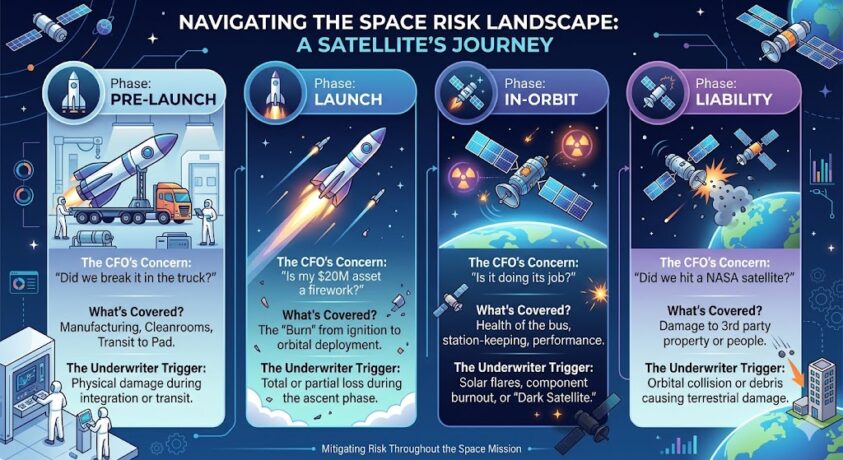
Product Roadmap: Pre-Launch, Launch, and In-Orbit Risk Management
When SpaceTech companies grow, the transition between one phase and the other is evident—it’s done carefully, with noticeable changes across every department. These changes should also go hand-in-hand with policy adjustments, taking place just at the right time to cover new needs.
1. Visualize the Hand-Off Points
A major industry risk lies in the gap in coverage during the hand-off between phases. For example, if a satellite is damaged while being bolted onto the rocket, would this be considered a pre-launch incident, or has the launch policy already started since the rocket is in ascent?
Tailored insurance coverage makes sure this gap is accounted for, giving CFOs much-needed peace of mind so risks don’t fall through the cracks when making the move to new phases.
2. Budgetary Planning
Insurance also works differently when it comes to space technology, as is only fitting for an industry with such specific risks. When discussing needs and prices, insurance policies are broken into a stack of sorts—space insurance is expensive, but it’s not paid all at once.
By breaking coverage into different sections, company leaders become aware of their capital expenditure (CapEx) timeline. For instance, pre-launch insurance is more affordable than the launch phase one (a one-time premium of a bigger size), reflecting funding rounds and company size. Conversely, in-orbit coverage is an ongoing operational expense.
3. Simplify Complex Triggers
Hand-off points in aerospace happen with very specific actions, which also activate specific insurance coverages depending on contractual risk. For a SpaceTech subcontractor, insurance liabilities shift based on explicit technical milestones rather than just dates on a calendar.
For example, suppose a software subcontractor delivers a navigation algorithm. If a system failure occurs during simulation testing, it triggers standard Professional Indemnity or Cyber E&O coverage for rectification.
However, once that code is formally integrated into the launch vehicle’s operational flight computer—a specific contractual hand-off point—the liability profile shifts. If a glitch occurs after this integration milestone, it can trigger massive Business Interruption or Product Liability claims due to project delays, even if the rocket never leaves the ground.
Beyond the Hardware: The Investor-Ready Approach
The space insurance market is all about protecting a founder’s hard work. It also provides value that was once additional and is now considered a requirement for investors to consider a startup eligible for partnering. Today, on top of protection, it’s a major selling point. Let’s see how key risks and policies work for founders and investors.
1. D&O: Beyond Just Investor Protection
Although Directors and Officers (D&O) insurance holds company leaders liable for aspects such as disclosure, it’s also an important regulatory liability.
For instance, the Federal Communications Commission (FCC), the FAA, and international bodies, such as the UN’s International Telecommunications Union (ITU), are tightening rules on orbital debris with regulations like the ‘5-Year Rule’, which mandates the de-orbiting of satellites up to five years after completing their mission. If a startup board fails to oversee a compliant de-orbiting strategy and the company gets hit with a massive deferral fine or loses its license, shareholders can sue for breach of fiduciary duty.
Ultimately, a specialized D&O in the SpaceTech industry is a startup’s license to operate at the board level.
2. Tech E&O/Cyber: The Downstream Domino Effect
Many companies in the sector offer their space technology as a Space-as-a-Service of sorts, providing data, pings, or imaging to ground-based clients in agriculture, logistics, defense, and more. Being a third-party in tech means any downtime can become a legal nightmare.
If a satellite has a software glitch and fails to deliver critical climate data to a multi-billion-dollar hedge fund, this quickly becomes a Tech E&O claim for financial loss. This glitch can come from anywhere between a coding error and a C2 hijacking attack—the latter can go as far as to allow hackers to use the satellite as a kinetic weapon against another asset.
Traditional cyber policies might miss these industry-specific risks, which is why company leaders need a policy that bridges the gap between digital breach and physical orbital collision.
3. IP Liability: The New Space Race
SpaceTech is an industry that thrives on breakthroughs from innovations, making it a patent minefield. It’s not uncommon for startups to be accused of infringing on legacy aerospace patents or borrowing proprietary propulsion tech, which makes IP insurance an essential element in a startup’s risk management tools.
This coverage can be pivotal in a SpaceTech company’s future if they ever run into trouble regarding IP. In short, it provides the defense capital to fight a patent troll or a big prime contractor who tries to litigate a startup out of existence.
4. Human Capital: Key Person and Kidnap & Ransom
Aerospace is still a rather niche industry when it comes to human capital. Its specialized nature means that, in many cases, even entry-level engineers have to go through several fields of study and experience before being considered proper candidates in both the private and public sectors.
So, in what could be referred to as a “boutique” industry, the loss of a single Chief Engineer can literally ground a mission. For companies growing their leadership positions, taking care of their workforce is for their survival. As such, when operations move to a more experimental phase, leaders should go beyond just Key Person insurance and consider policies, such as Kidnap & Ransom, especially if teams are travelling to emerging launch sites far from their home base.
It might sound far-fetched. However, for a Series B CFO, it’s a standard line item for high-value talent.
Real-World Case Studies
The margin for error in aerospace engineering is notoriously microscopic, but mission-ending failures rarely stem from a lack of technical brilliance. Instead, they almost always trace back to systemic miscommunications, unverified assumptions, and flawed integration between contractors and agencies.
As the following case studies demonstrate, a seemingly minor oversight—such as an unvalidated unit conversion or unrequalified legacy software—can bypass redundant safeguards and trigger immediate, catastrophic failure. In the space sector, operational oversights at the contractor level don’t just cause delays; they ground entire programs, wipe out hundreds of millions of dollars in capital, and permanently alter a company’s trajectory.
Case Study 1: Mars Climate Orbiter (1999)
- Contractor: Lockheed Martin Astronautics
- What happened: The Mars Climate Orbiter (MCO) was lost during orbital insertion when it entered Mars’ atmosphere at far too low an altitude and disintegrated. The root cause was traced to inconsistent units used in navigation software supplied by Lockheed Martin.
- Lockheed Martin delivered thrust data in Imperial (pound‑seconds)
- NASA JPL navigation software assumed Metric (newton‑seconds)
- The mismatch was never detected during systems integration or testing
- Result: Trajectory errors accumulated until catastrophic failure during Mars orbit insertion.
- Why this is a SpaceTech‑company‑driven failure: Lockheed Martin, as the spacecraft builder and software supplier, did not adhere to NASA’s Software Interface Specification (SIS), despite it clearly defining required units. The code itself was “correct” locally but incorrect at the system interface level.
- Mission‑level impact:
- ~$327 million mission lost
- Loss of scientific payload and communications relay for the Mars Polar Lander
- Multi‑year setback to NASA’s “faster, better, cheaper” Mars program
- Key takeaway: Mission failure emerged from contractor‑level interface assumptions that were never validated end‑to‑end.
Case Study 2: Ariane 5 Flight 501 (1996)
- Contractors: CNES / ESA industrial consortium (including Airbus, Aérospatiale, Matra)
- What happened: The maiden flight of Ariane 5 self‑destructed 37–40 seconds after launch due to a failure in the Inertial Reference System (IRS) software.
- Software reused from Ariane 4 was assumed safe
- Higher horizontal velocities in Ariane 5 caused a numeric overflow
- Overflow exception shut down both primary and redundant guidance systems
- Diagnostic data was misinterpreted as flight commands → violent nozzle deflections → breakup
- Why this is a SpaceTech‑company‑driven failure: The failure came from software heritage reuse without requalification.
- A variable deemed “safe” in Ariane 4 was no longer safe in Ariane 5
- Overflow protection was explicitly disabled for performance reasons
- Both “redundant” systems shared identical software and assumptions
- Mission‑level impact:
- Loss of launch vehicle and four satellites
- Estimated loss: €370–500 million
- Delayed Ariane 5 programme and reputational damage to ESA
- Key takeaway: Legacy contractor software, when reused without environment revalidation, can become a single‑point mission failure.
The 2026 Regulatory Landscape
As the private SpaceTech sector fuels its commercialization prospects—2025 set the record as the year with the most orbital launch activity—national and international organizations have kept pace with new tech advancements and have released new regulations that impact startup liability.
One of the biggest shifts has been the ‘5-Year Rule’, which replaced a decades-old de-orbiting rule, and was unanimously approved by the FCC to urge low Earth-orbiting (LEO) satellites to de-orbit within five years of completing their mission. This rule intends to reduce the risks of collisions in orbit and avoid debris clutter. Although it’s been instituted as a safety and sustainability measure, companies such as tech giant Amazon have questioned its efficacy and demanded more leniency from regulators.
Moreover, in 2025, the FAA issued licenses for over 200 space operations under a new launch regulation that took full effect last year after being created in 2021. This rule simplifies the licensing process and allows space vehicles to launch more frequently, igniting the flame for more space operations in the US. Although this makes it easier for SpaceTech companies to launch their projects, it’s critical to adjust their internal licensing process to meet the new standards.
Internationally, the EU launched the Space Act proposal in 2025, which designates space systems as part of the Union’s critical infrastructure and requires more robust cybersecurity practices in accordance with the NIS 2 Directive and the Cyber Resilience Act.
The International Traffic in Arms Regulations (ITAR) have also undergone extensive changes in the past year, loosening requirements on some aspects and adding them in other respects, such as seeking approval before engaging in defense brokering. SpaceTech companies involved in defense must heed these shifts and adapt accordingly.
Turning Risk into a Competitive Edge
As SpaceTech booms, founders must understand that insurable companies are also investable ones. Competition is also growing, leading startups to maintain their competitive edge, for which proper insurance protection is essential.
Space technology is changing at an unprecedented pace, and so are companies and their risks. It’s never been more important to build a risk management strategy that stays current with new advancements and company phases, keeping projects shielded, whether they’re in their infancy, transitioning, or reaching maturity.
The space insurance market is constantly adapting to the industry’s rapid developments to ensure the success of its clients. Working with specialized insurers helps SpaceTech company leaders meet the expertise they need through every step of their growth, allowing for rigorous policy audits and updates when new milestones and phases take place.
Insurance Rebuilt, End-to-End